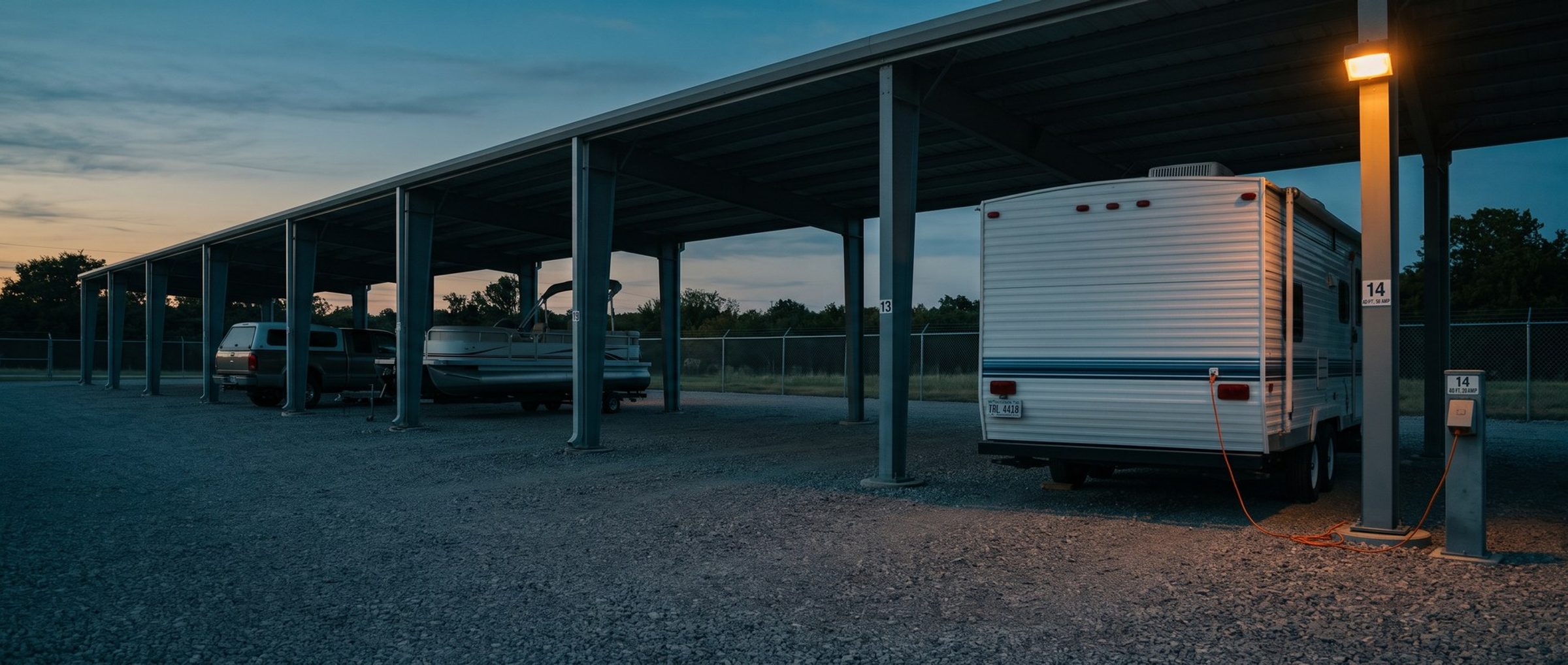
A storage facility with a gravel lot out back is running two businesses. One rents rooms to people with too much stuff. The other rents parking spaces to people with something too big for the driveway: a 33-foot camper, a bass boat on a trailer, a classic car that only comes out in June. The searches are different, the prices are different, the seasons are different and the renters want different things.
Many storage accounts put them in the same campaign anyway, and that's where the vehicle side gets lost. This bonus chapter makes the case for giving RV, boat and vehicle storage a campaign, a budget, bids and pages of its own, using Keyword Planner data from across the US, the ads and reviews in our example market, Oklahoma City, and what renters say they're looking for.
One in Twenty Storage Searches Is for an RV, a Boat or a Car. Advertisers Bid Far Less for Those Renters.
The vehicle searches are bigger than many owners expect. Across the US, Keyword Planner reports these monthly averages:
- "rv storage near me": about 135,000, in the same group as "camper storage near me"
- "car storage near me" and "vehicle storage near me": about 90,500
- "rv storage": about 49,500
- "car storage": about 33,100
- "boat storage near me": about 33,100
- "boat storage": about 18,100
- "covered rv storage near me" and its indoor variants: about 9,900
- "rv and boat storage": about 6,600
Together the RV, boat and vehicle searches come to about 568,850 a month, roughly 5.3% of US consumer storage-rental searches and 10.8% of the ones that don't name a chain. "rv storage near me" alone is about 13.5% as large as "storage units near me."
The prices are what set them apart. Keyword Planner's high top-of-page bid for "rv storage near me" is about $7.41, against $21.81 for "storage units near me": about a third. Boat storage near me sits around $6.86, car and vehicle storage near me around $8.68. The main storage searches run from about $18 to $25 at the high end.
Local numbers can differ on thin searches. In our example market, "rv storage near me" carried a high bid of $10.04 and "boat storage near me" $15.43 on about 210 searches a month, both higher than the national figures. Check your own market before setting bids.
Put those searches in the main campaign and two things go wrong. The budget is shared, so the unit searches can use up most of it and leave little for RV searches. And the reports blend searches with a $7 high bid and searches with a $22 one, so neither cost per move-in means much. A separate campaign fixes both: its own budget, its own bids set from what a vehicle space rents for, and its own numbers.
Value the move-ins separately too. Chapter 3 set each unit move-in's conversion value from the rent and the typical stay. Do the same for vehicle spaces with your own rent roll: what an RV or boat space rents for and how long those tenants stay. A space that rents for less than a 10x10 should carry a lower value, and a covered spot that stays rented for years may carry a higher one. Mixing them into one number gives you, and later Smart Bidding, the wrong price for both.
Boat Storage Searches Double Between September and May. Car Storage Searches Peak in the Fall.
Vehicle storage also keeps its own calendar. Averaged over four years of Keyword Planner data:
- "boat storage" peaks in May at about 54,950 searches and bottoms out in September at about 26,625, a swing of about two to one
- "rv storage" also peaks in May, at about 91,375, against about 63,625 in September
- "car storage" peaks from October through December, at about 60,000 to 64,000 a month, against about 37,550 in August
The near-me versions don't share that May peak. "boat storage near me," for one, peaked in October in the same data, so check the month-by-month figures for the exact searches in your campaign.
Our reading: owners searching "rv storage" and "boat storage" search hardest in spring, as the season starts, and car storage climbs as owners put summer and classic cars away for the cold months. A separate campaign lets the budget follow those curves: more for RV and boat in spring, more for car storage in the fall, without starving the unit campaigns that follow their own seasons (Chapter 7).
Google's Ad Library Shows No Search Ads From 14 Local RV and Boat Lots. A Storage Facility With a Vehicle Lot Can Own Those Searches.
In our example market, we looked up 14 local RV, boat and vehicle lots in Google's Ads Transparency Center. None showed any ad in the Transparency Center. Nine map listings for RV, boat and vehicle lots appeared across four of the searches we ran, so for those lots the free listing is doing what work gets done. Among the 12 independent and small-portfolio storage sites we studied, 10 rent RV, boat or vehicle space, and 3 make it their main product.
Most ads that mentioned vehicles came from regional and national operators: RV, boat, vehicle, trailer or parking words appeared in 18 readable ads from small regional operators and 18 from national brands, against 6 from just 3 local independents. For a facility with a vehicle lot, that's an opening: cheap clicks, and few local competitors buying them.
The reviews tell you what to put in those ads. In the 1,895 Google reviews we read, 85 mentioned an RV, boat, camper or similar, 63 of them in four- or five-star reviews, and 60 of the 85 were at the 10 listings with RV or boat in their name. The praise is concrete:
- "Very secure with plenty of room to back boats into the units."
- "The larger units for RVs, Travel Trailers, boats, etc., have lights and outlets, great to help keep your batteries on a slow charge."
- "He met me at the gate and showed me around the property, then stuck around to help me back in my 33' camper."
Covered spots, power for batteries, driveways wide enough to back a trailer, and a gate that keeps the lot secure: those are the headlines. The complaint that shows up most at these lots in our sample is a rent increase after the lot changed hands, the subject of Chapter 15.
An RV Renter Is Shopping for a Parking Space, Not a Unit. A Unit Page Loses That Renter in Seconds.
In our experience, the most common mistake on the vehicle side is sending an RV search to the storage unit page. A renter with a 33-foot camper scans for one thing first: will it fit? A page of 5x10 and 10x10 units answers the wrong question.
Give the vehicle campaign its own pages, the way Chapter 4 gave climate-controlled units theirs:
- Space sizes by length, so a renter can match a 25-foot boat or a 38-foot motorhome to a space without calling
- Covered, uncovered and enclosed options with prices for each
- Power, lighting and dump stations where you have them, since renters name them in reviews
- Gate hours and access, so a renter knows when a trailer can go in and out
- Photos of the lot and the driveways, showing the room to turn
Split the ad groups the same way: RV and camper, boat, car and vehicle, covered or indoor. Each one points to the matching section of the vehicle page.
The vehicle campaign also needs its own negative list, because the vehicle searches pull in shoppers who aren't renting. Keyword Planner groups "rv storage buildings" with "camper storage building," about 720 searches a month at bids under $3.40: people pricing a carport or a metal building for their own land. "covered boat," about 14,800 a month, sits close to boat storage in the idea lists but can just as easily mean a boat cover, so check its search terms before bidding on it. Searches for buying a trailer, for RV dealers and for RV parks with nightly campsites belong on the list too, along with the chain names from Chapter 5. "public storage rv storage," about 1,000 searches a month, is a renter who already picked a chain.
Distance works differently as well. One renter on Reddit described looking for RV storage "in the city without having to RV over 20-30 miles away." Vehicle owners care about how far they'll tow, so set the vehicle campaign's area from where your current vehicle tenants actually live, which may be wider or narrower than the unit campaign's.
The Business Profile matters here too. Category lists compiled from Google's category picker include RV storage and boat storage facility categories; confirm them in your own profile's picker. Google's guidelines say to use as few categories as possible and to describe the core business, so a facility whose lot is a sideline might add one as a secondary category, while a facility that mainly rents vehicle space would lead with it. For later campaigns, Google's audience lists also include in-market segments for Campers & RVs and for Boats & Watercraft, which give Demand Gen (Chapter 11) a closer starting point than storage units get.
Next: Rate Increases Cause the Most One-Star Storage Reviews. Move-In Ads Must Show the Rent for Month Two.
Chapter 15, the second bonus chapter, covers move-in specials, fees and rate increases, and what an honest storage ad has to say about month two. Every chapter is linked from the Google Ads for Self Storage guide home, and Chapter 13 covers AI Max. Our Google Ads agency team builds vehicle storage campaigns for facilities with a lot out back.