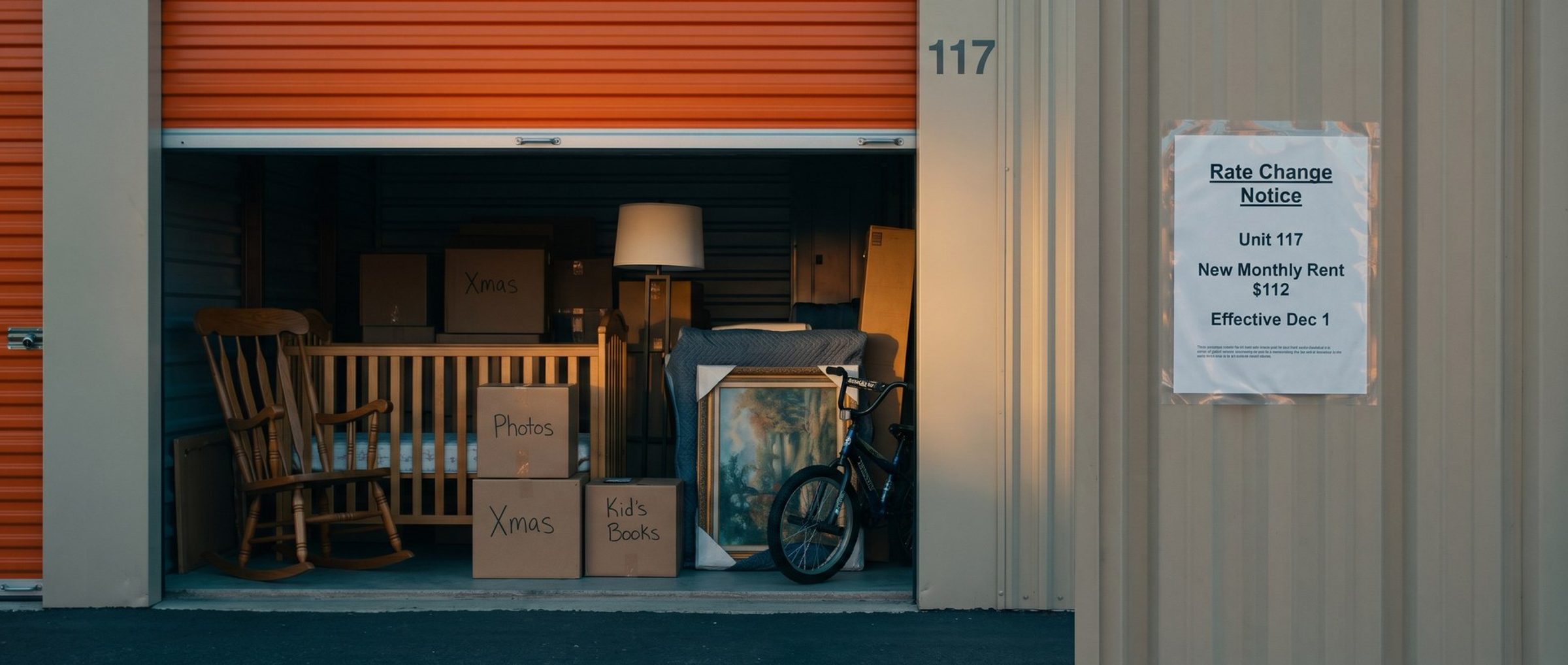
Storage has a business model that renters have learned to see coming. A low first month brings the tenant in. Moving out is a hassle, and operators count on that when the rent goes up. One renter in our example market spelled it out in a one-star review: "advertise an attractive rate, count on the fact that moving stored belongings is logistically painful, then raise prices steadily until the customer either accepts the new rate or leaves."
That's the background every storage move-in ad runs against. A "$1 first month" headline isn't read in a vacuum; it's read by people who have heard what happens in month four. This last bonus chapter covers what renters complain about, what Google's ad policies and the FTC's "Free" guide require of a promotion, which states add their own pricing rules, and how an independent facility can turn the industry's biggest complaint into a reason to choose it. None of it is legal advice; have counsel review your promotions and fee disclosures in each state you operate in.
Rent Raised After Move-In Was the Top Complaint in 88 of 394 One- and Two-Star Storage Reviews. Theft Came Second at 48.
We read every one- and two-star review in our sample of 1,895 Google reviews from 56 storage listings in our example market, Oklahoma City, and coded each one by its main complaint. Rent raised after move-in led with 88 of the 394, about 22%. Break-ins and theft came next at 48, then rude staff at 47. Add the other money complaints, such as fees, billing errors, a quoted or promotional price that wasn't honored, and move-out charges, and money was the main complaint in 156 of the 394.
Renters online describe the same pattern. One Reddit commenter's advice to another: "be prepared for the rate to increase within 3 months." A one-star reviewer put the loyalty problem plainly: "new customers are getting lower move-in rates for the same space, while I being a loyal customer, get forced out by a massive rate increase."
Chapter 3 showed the large operators' side of it, from their own annual reports. Independents aren't exempt. Of the 26 rate-increase complaints at independent listings in our sample, 16 described the facility being sold first. For a renter, a change of owner can be when the increases start.
For ads, the lesson is that the first month is the part renters trust least. The ad that wins their confidence is the one that tells them about month two before they ask.
Google Rejects Storage Ads That Hide Recurring Rent or Fees. A $1 First Month Needs the Monthly Price Beside It.
Google's misrepresentation policy has a section on dishonest pricing practices, and several of its examples could have been written about storage. Not allowed: "Not disclosing the total price, including all taxes, fees, and surcharges," "Omitting recurring costs and the billing interval," and "Not disclosing late payment fees." Google's fix is plain: the landing page should clearly disclose "the full expense that a user will pay."
A separate policy on unavailable offers covers the other storage habit. Google doesn't allow "Promoting a deal that is no longer active; promoting a price that is inaccurate." A "$1 first month" ad still running after the special ended, or advertised for unit sizes that aren't available, fits that example.
Google's pages don't name storage, admin fees or tenant insurance. Our reading of what a storage move-in ad's landing page should carry, next to the offer:
- The monthly rent after the special, for each unit size the special covers
- The one-time admin fee, if there is one
- Whether insurance or a protection plan is required, and its monthly cost
- Late fees, since Google names them
- Which sizes qualify and that the special is still running
In the ad itself, a headline can carry both numbers. "10x10: $1 Month 1, $89 After" fits in the 30-character limit, and it answers the question renters ask first. A promotion asset can carry the discount, and Google's price assets can list each unit size with its monthly rent.
Both assets come with their own rules. Google's promotion asset rules want the advertised price to be accurate, easy to find on the landing page, and consistent with the asset's own wording. Price assets show as up to 8 cards, need at least 3 items, and Google recommends listing 5 or more. Our reading for storage: put the regular monthly rent for each size in the price asset, such as 5x10, 10x10 and 10x20 with their rents, and keep the "$1 first month" in the promotion asset, where its terms can sit beside it. A price card that shows $1 for a 10x10 is the first-month problem in a smaller box.
The FTC Says the Terms of a "Free" Offer Belong Next to It. An Asterisk at the Bottom of the Page Doesn't Count.
The FTC's guide on the word "Free" dates from 1971 and never mentions storage, but our reading is that a first-month-free special fits its description closely: a service handed over at no charge on the condition that the renter pays for the months after it. Three of its points matter most.
First, the conditions go with the offer. The guide says all the terms "should appear in close conjunction with the offer," and that a footnote marked by an asterisk "is not regarded as making disclosure at the outset." A minimum stay, an admin fee, a required protection plan and new-tenants-only belong next to the words "First Month Free," not in small print below the fold.
Second, the paid months should be at the regular price. The guide defines "regular" as the price the business has openly sold at for a reasonably substantial period, such as 30 days, and says buyers can expect the seller won't recover the free item's cost by marking up what they pay for. Our reading: a "free" first month followed by rent above the facility's usual rate for that unit is the pattern the guide warns against.
Third, a free offer should be special. The guide says a single kind of service shouldn't carry the same "Free" offer in a trade area for more than six months in any twelve. A first-month-free deal that never ends stops being an offer and becomes the price. Renaming it doesn't help; the guide says words like "bonus" or "given without charge" don't cure a deceptive free offer.
California and Colorado Want Every Required Fee Inside the Advertised Price. A Required Storage Admin Fee Counts.
Of the 12 states we checked, none regulates move-in specials by name, but a few have rules that reach storage ads anyway. Neither of the laws below names storage; this is our reading of how they apply.
California has two. Its all-in pricing law, in effect since July 1, 2024, prohibits advertising a price for consumer rentals "that does not include all mandatory fees or charges," apart from government taxes and shipping. The state Attorney General's guidance says optional fees don't need to be included. Our reading: a required admin fee goes into the advertised price; an optional protection plan doesn't. Separately, for storage agreements entered into on or after January 1, 2026, California requires the first page of the agreement to show any promotional status, how long the promotion lasts, and "the maximum rental fee that the owner could charge during the first 12 months."
Colorado passed a deceptive-pricing law that took effect January 1, 2026. It requires anyone advertising a price to clearly disclose the total amount a person may pay, not counting government charges or shipping.
The FTC's federal junk-fee rule, by contrast, covers only live-event tickets and short-term lodging, so it doesn't reach storage.
Tenant insurance has its own wording rules. Of the 12 states we checked, California, Florida, New York, Illinois and North Carolina require a facility that sells storage insurance to tell renters it isn't required to rent, and several others require saying that other coverage can satisfy an insurance requirement. Those rules govern the written materials and notices; our reading is that the same wording belongs on the landing page.
For a facility in any state, the safest page is the California one: the all-in monthly price, the fees, the insurance terms, and how high the rent can go in the first year.
A Published Rent Increase Policy Answers the Top Storage Complaint Before a Renter Signs.
Here's where an independent facility has room the chains don't use. Many renters already expect a smaller operator to treat them better. On Reddit, one renter summed up a view several others shared: "family owned typically translates to better service, more flexibility, and far less aggressive price increases." Chapter 8 showed how often renters raise that point.
A belief isn't a promise, though. A facility that actually keeps increases modest can say so, specifically:
- How often rent can change, for example no more than once a year
- How much notice tenants get, in writing
- The most the first-year rent can reach, the same figure California now requires on agreements
That policy belongs on the landing page, next to the move-in price, and it can go into the ads as well: a headline like "Rent Locked for 12 Months" or a description that names the notice period. Only say it if it's true and you'll keep it; Chapter 8's point about one-star reviews applies here twice over.
The payoff is in the numbers this guide has used throughout. Chapter 3 valued a tenant on rent times stay. We'd expect a renter who trusts next year's rent to be more likely to stay, and a facility that keeps its promises collects the reviews that lift it on the map (Chapter 12). The cheapest way to stand out in a market full of $1 first months is to be the facility that tells renters what month thirteen costs.
Your First Storage Ad Dollars Belong on Searches Like "Storage Units Near Me." Performance Max and AI Max Come Later.
That's the last chapter of the guide. Here's every chapter, in reading order. One note on timing: location assets and the Business Profile work from Chapter 12 belong in the account from month one, while Performance Max, Demand Gen and AI Max wait their turn as described.
- Count the move-in
- Start at storage units near me
- What one tenant is worth
- A page for every unit type
- Set the chain names aside
- Ten keywords in exact match
- Bid by hand on price searches
- Write ads in renters' words
- Reach movers from out of town
- Fence off tenant pages in Performance Max
- Build a storage audience for Demand Gen
- Get on Google Maps beside the chains
- Chain names out of AI Max
- Bonus: RV, boat and vehicle storage
- Bonus: show the rent after the special (this chapter)
The Google Ads for Self Storage guide home keeps all 15 chapters in one place. Our Google Ads agency team builds storage accounts in this order, with move-in ads that show renters the whole price.