
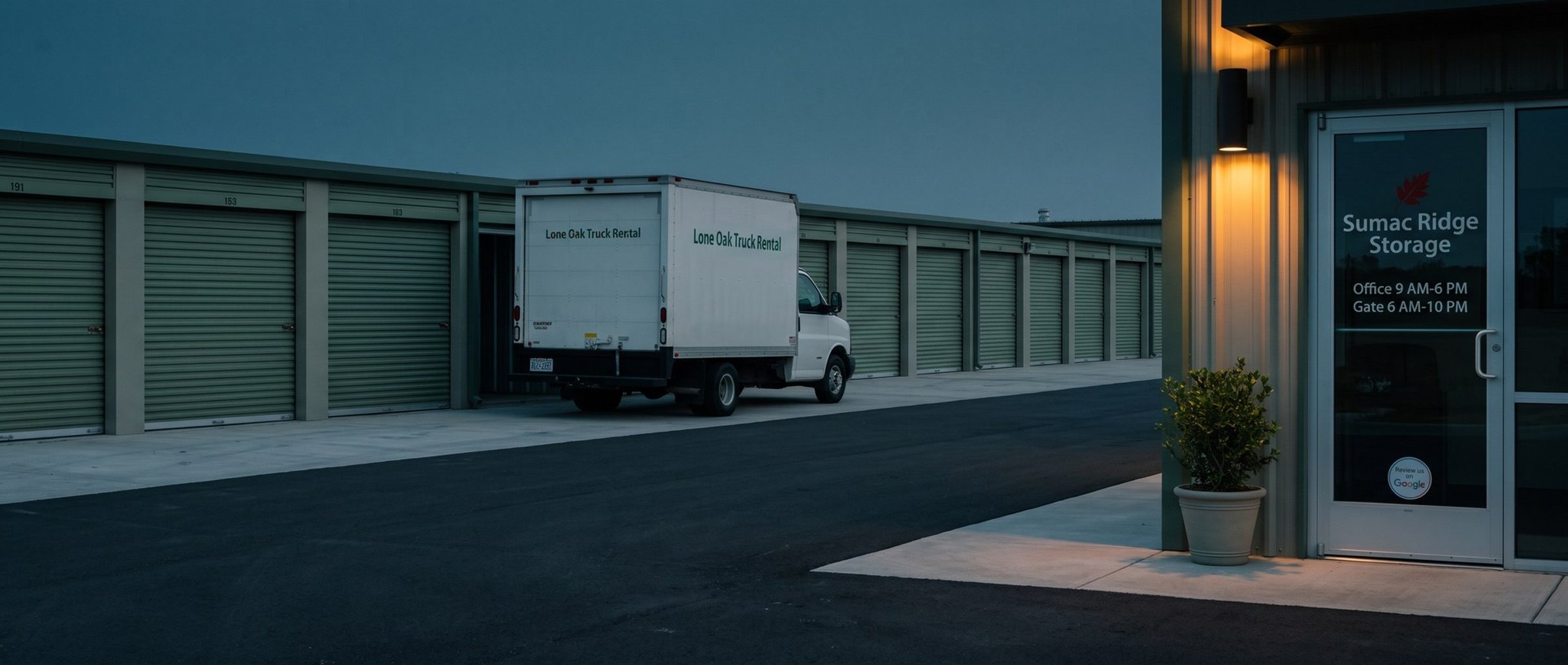
On a phone, the map is often the first thing a storage renter sees: three pins, three names, three star ratings and a "Directions" button. Which facilities land in that box matters as much as any ad below it.
In our example market, those spots mostly belonged to the chains, and the same is likely wherever national brands have built facilities. This chapter shows how lopsided the map is, why reviews are a big part of the reason, how an independent facility gets its Search ads onto Google Maps with location assets, and where Google's Local Services Ads fit for a storage operator. The examples come from our example market, Oklahoma City.
In the Storage Map Pack We Checked, One Chain Held 27 of 78 Spots. Local Independents Held 4.
We ran 28 storage searches in our example market in October 2026, from "storage units near me" to unit sizes and town names, and recorded the map listings that appeared on each. A map pack showed on 26 of the 28 searches, with 78 listings in all. Here's who held them:
- National brands and REITs: 44 listings on 19 searches. One chain, Extra Space, held 27 by itself; Public Storage had 8.
- Small regional operators: 12
- RV, boat and vehicle lots: 9, on four searches: the RV, boat, car and business storage searches
- Movers and portable storage companies: 5
- Local independent facilities: 4, on four different searches
- Other: 3 wine shops on a wine storage search, and 1 listing for a management company's brand
So more than half the map spots went to national brands, and one chain held a third of them by itself. The independents, the operators this guide is written for, showed up four times in 78.
That isn't a judgment on their facilities. It's a measure of how Google picks map listings, and the next section covers the part an owner can change.
A Chain's Storage Listing Typically Has Six Times the Google Reviews of an Independent's Listing. Google Counts Reviews When It Ranks the Map.
Google explains the free map listings in its Business Profile help, and storage fits the pattern neatly. A facility shows up when its profile fits the renter's search, when it's close to where the renter is, and when it's well known. That last factor, which Google calls prominence, is where reviews come in: Google names the count of reviews and the star rating among the things that can lift a business's local ranking.
In our example market, we found 88 storage listings with at least four reviews. The national brand listings had a median of 311 Google reviews each. The independent listings had a median of 48. Average ratings were close, 4.77 stars for the national brands and 4.65 for the independents. The chains don't have better reviews so much as many more of them.
Distance is the factor an owner can't change, and relevance mostly comes down to filling in the profile accurately. Reviews are the factor a facility can build on purpose. The practical fix is a routine: ask every new tenant for a review a few days after move-in, by text or email, with a direct link. Chapter 8 showed what those reviews tend to say, and a steady stream of them also feeds your ad copy.
Two rules keep the routine safe. Google's review policy doesn't allow businesses to offer incentives, such as a discount, in exchange for a review, so "leave a review, get $10 off next month" is out. And Google says merchants shouldn't pressure customers to leave reviews while they're on the premises, which rules out handing a tenant a tablet at the counter on move-in day.
Answer the reviews too, the bad ones especially. A short, specific reply to a one-star review about a rent increase or a broken gate tells the next renter that someone at the facility reads what tenants write and fixes what they can. Google's own tips list replying to reviews as a way to stand out. Keep replies in plain language; in Chapter 8, owner replies were where words like "solutions" and "amenities" crept in, and renters don't talk that way.
While you're in the profile, get the basics right. Google's guidelines say storage facilities should list office hours, or front gate hours when there's no office. Each facility gets one profile at its own address, with permanent signage, and the category should describe the business, such as a self-storage facility, not stand in for keywords.
Location Assets Put a Storage Ad on Google Maps With Directions and a Call Button. Without Them, the Ad Stays Off the Map.
Reviews build the free listing slowly. An ad with location assets can show on Maps as soon as the campaign runs. Google's help page lists the campaign types that can serve on Google Maps, and a plain Search campaign is only on the list when it has location assets, which pull your address and details from your linked Business Profile.
With location assets in place, a storage Search ad can show in the Google Maps search results. Google reports three kinds of clicks from these ads: people opening the listing details, people asking for directions and people tapping to call. For a storage renter deciding between three facilities a few miles apart, directions and a call button are the two actions that matter.
The setup is short:
- Link your Business Profile to Google Ads and add location assets at the account or campaign level.
- Target the area your renters drive from, the same way Chapter 9 set the local campaigns, and raise bids for people closest to the facility.
- Use local keywords, the town names and near-me searches from Chapter 6, which is what Google's own setup guidance points to.
For a group with several facilities, each location needs its own Business Profile so each one can carry its own location asset. The ad then shows the nearest facility's address and distance to the person searching, which matters when a renter is comparing facilities a few miles apart.
Two limits are worth knowing. Google says you can't run ads only on Maps, so the map placement comes with the Search campaign, not instead of it. And the free listing and the ad are separate things: fixing a wrong pin or address happens in the Business Profile, not in Google Ads.
Local Services Ads Rank Storage Facilities on Reviews and Answered Calls, Not Just on the Bid.
Local Services Ads work differently from everything earlier in this guide: ads that charge for leads such as calls and messages instead of clicks, shown on Google Search and Maps. "Storage" is on Google's list of US categories, so a storage facility can apply. Whether the ads run depends on the area; Google says to check eligibility for yours.
Google's screening page lists background, registration, insurance and license checks for storage businesses, every one marked as required for select users only. In practice, Google may ask a storage facility for any of them, so have the business registration, insurance certificate and owner details ready before applying.
Ranking is where storage operators should pay attention. The order of storage listings comes from an auction that weighs the bid alongside Google's guess at whether each facility will turn the renter into a lead. That guess draws on things an operator controls. Google warns that missed calls may count against a facility's responsiveness, and the profile's quality covers its star rating, review count, how fast it replies and the photos it posts. Recall Chapter 3: nobody in the office or on the phone was the main complaint in 32 of the 394 one- and two-star reviews in our sample. A facility with that problem will pay for it twice in Local Services Ads, in lost leads and in lower placement.
One rule matters most for small portfolios. When one company runs several storage sites in the same area, Google picks a single one of them, whichever ranks best, for each renter's search. Two facilities across town from each other under one brand don't double their chances. They compete for one spot.
Local Services Ads are also changing. Google is moving its pay-per-lead ads into Performance Max, starting with a first group of US home and storefront service businesses. Its first group, which began moving in August 2026, covers trades such as plumbing, HVAC and moving, but storage isn't listed in it, and Google's schedule moves all remaining categories by 2027. After the move, Google says campaigns stay keywordless and manual cost-per-lead bidding is no longer supported.
Put together, Local Services Ads are a test, not a foundation. There's no keyword control, so you can't keep them off chain names or auction searches the way Chapters 5 and 10 do. Run them beside a working Search account, once the phones are answered reliably and the reviews are building, and compare their cost per move-in against Search before giving them more budget.
Next: AI Max Can Spend a Storage Budget on Rival Chains' Names. Four in Ten Storage Searches Include One.
Chapter 13 covers AI Max, the last step in a storage account, and the fences it needs first. Every chapter is linked from the Google Ads for Self Storage guide home, and Chapter 11 covers Demand Gen. Our Google Ads agency team sets up location assets and Business Profile links for storage operators as part of every account build.